
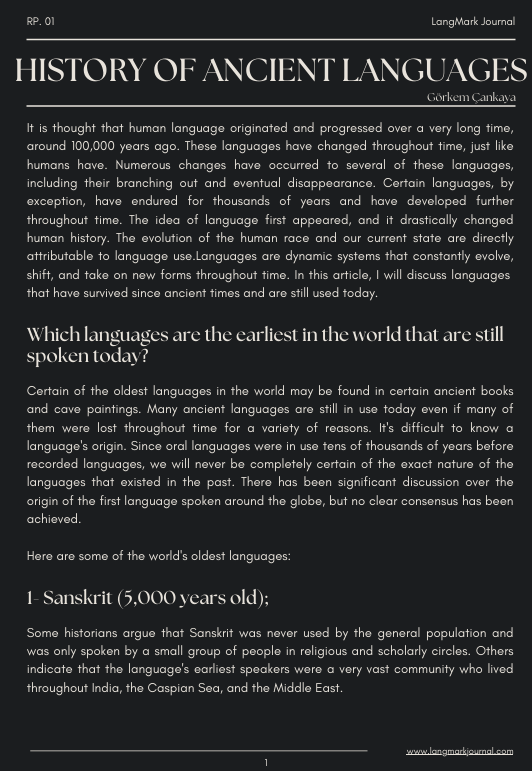
Exploring the journey of some of the world’s oldest living languages, from Sanskrit and Tamil to Greek and Hebrew, and how they’ve managed to survive through centuries of change. These languages are more than just means of communication; they are living pieces of human history.
In this research paper, it is aimed to explore the origins, evolution, and current usage of the world’s oldest languages. By examining languages such as Sanskrit, Tamil, Greek, Chinese, and others, the paper highlights how certain linguistic traditions have endured for thousands of years, surviving, cultural transformations, and the rise and fall of empires. Through this exploration, the importance of language as a cornerstone of human civilization and a key factor in preserving cultural identity and historical continuity, is emphasized.
In writing this paper, close attention is paid to several important aspects. Historical accuracy is the priority, as the timelines and facts about each language are carefully supported by reliable sources. Additionally, the paper reflects a comparative approach, analyzing grammatical, phonological, and syntactic features across different languages. Cultural context is also included in the discussion, ensuring that the linguistic analysis is enriched by an understanding of each civilization’s history, religion, and geography.
Team LangMark

 LangMark